 W
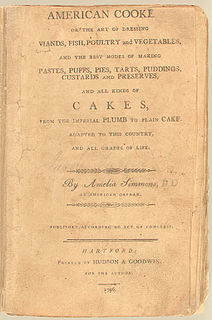
WAmerican Cookery, by Amelia Simmons, is the first known cookbook written by an American, published in Hartford, Connecticut in 1796. Until then, the cookbooks printed and used in the Thirteen Colonies were British. Its full title is: American Cookery, or the art of dressing viands, fish, poultry, and vegetables, and the best modes of making pastes, puffs, pies, tarts, puddings, custards, and preserves, and all kinds of cakes, from the imperial plum to plain cake: Adapted to this country, and all grades of life.
 W
WA blue-plate special is a low-priced meal that usually changes daily: a term used in the United States and Canada by restaurants, especially diners and cafes.
 W
WThe Boston Cooking-School Cook Book (1896) by Fannie Farmer is a 19th-century general reference cookbook which is still available both in reprint and in updated form. It was particularly notable for a more rigorous approach to recipe writing than had been common up to that point.
 W
WBrunswick stew is a tomato-based stew generally involving local beans, vegetables, and originally small game meat such as squirrel or rabbit, though today often chicken. The exact origin of the stew is disputed. The states of Virginia, North Carolina, and Georgia all claim its birth, with Brunswick County in Virginia and the city of Brunswick in Georgia both claiming it was developed there. It may have originated earlier in some form in the city of Braunschweig in the Duchy of Brunswick-Lüneburg in today's northern Germany.
 W
WBurgoo is a stew, similar to Irish or Mulligan stew, often served with cornbread or corn muffins. It is often prepared communally as a social gathering. It is popular as the basis for civic fund-raisers in the American Midwest and South.
 W
WThe cuisine of the antebellum United States characterizes American eating and cooking habits from about 1776 to 1861. During this period different regions of the United States adapted to their surroundings and cultural backgrounds to create specific regional cuisines, modernization of technology led to changes in food consumption, and evolution of taverns into hotels led to the beginnings of an American temperance movement. By the beginning of the Civil War, the United States cuisine and food culture could define itself separately from that of the rest of the world.
WThe cuisine of the Thirteen Colonies includes the foods, bread, eating habits, and cooking methods of the Colonial United States.
 W
WRufus Estes was a former slave who worked as a chef aboard luxury railway cars operated by the Pullman Company in the 19th century.
 W
WFannie Merritt Farmer was an American culinary expert whose Boston Cooking-School Cook Book became a widely used culinary text.