 W
WThis is a list of the buildings, sites, districts, and objects listed on the National Register of Historic Places in the Republic of Palau. There are currently six listed sites located in only four of the sixteen states of Palau. This National Park Service list is complete through NPS recent listings posted December 31, 2020.
 W
WThe Airai Bai in Palauan is a traditional meetinghouse in the Airai municipality on Babeldaob, the largest island in the island nation of Palau. It is located in the center of the village on a stone platform that had previously held earlier bais, and is located at the junction of two traditional stone pathways. The building is 68 by 20 feet, rising to a height of 40 feet (12 m) at its peak. Its facade and interior beams are decorated with depictions of Palauan legends. It was built around 1890, and underwent a major restoration in the 1970s. The building and site have long been the spiritual and civic centerpiece of the community.
 W
WKed Ra Ngchemiangel, also known as the Kamyangel Terraces, are a series of sculpted landforms in Aimeliik, a state on the island of Babeldaob, the largest in the island nation of Palau. Located near the Kamyangel River near its entry into Ngchemiangel Bay, the terraced hills are clearly manmade forms created in unknown antiquity, and are arrayed in a curve overlooking the bay. When viewed from head-on, many of these terraces have a stepped "crown and brim" appearance similar to that of a brimmed hat. One of the hills is terraced to a height of 190 feet (58 m).
WMeteu 'L Klechem is a historic stone monolith in Melekeok, a community on the island of Babeldaob, the largest island in the nation of Palau. It is a roughly octagonal stone, 7 feet (2.1 m) long and 2 feet (0.61 m) thick, and weighing about 3,000 pounds (1,400 kg). When recorded in 1976, it was used as a bridge across a local stream. The monolith is historically significant for its association with Metau, a warrior of the late 18th century. In 1785 Metau was ambushed and killed on Koror Island in revenge for attacks he had made on Yapese boats headed there. His body was held as a ransom, and was laid on this stone. Metau's brother Reklai paid the ransom, and in 1795 the stone and body were transported to Melekeok for burial. The stone sat at the main pier at Beriber until 1948, when it was moved to its present location.
 W
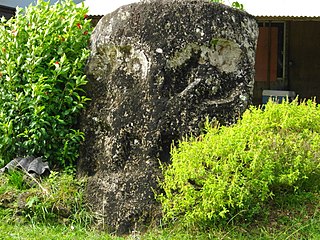
WOdalmelech is a striking prehistoric large carved stone face of a god-king, and surrounding garden with additional carved stones, in Melekeok, on Babelthuap island of the nation of Palau. It was listed on the United States National Register of Historic Places in 1976; the listing includes the Odalmelech stone itself and several others.
WOngeluluul is a historic stone platform in Melekeok, a community on Babeldaob, the largest island of the island nation of Palau. It is located in Old Melekok Village, about 100 yards (91 m) from the boathouse at the shore. It is separated from the main road by a small creek. The platform measures about 20 by 20 feet, and was originally fashioned out of finely paved stones, although it was in deteriorated condition when surveyed in 1976. The site is of local historical significance as a place where important secret meetings of local leaders took place, and is a type of site other major Palauan communities have. This platform was erected in 1750, and was the site of two significant peace treaties in Palauan history: one in 1793 and the other in 1870. The latter peace treaty marked the end of organized warfare between the clans of Palau.
 W
WPeleliu is an island in the island nation of Palau. Peleliu, along with two small islands to its northeast, forms one of the sixteen states of Palau. The island is notable as the location of the Battle of Peleliu in World War II.
WPeleliu is an island in the island nation of Palau. Peleliu, along with two small islands to its northeast, forms one of the sixteen states of Palau. The island is notable as the location of the Battle of Peleliu in World War II.