 W
WAlbrecht von Johansdorf was a Minnesänger and a minor noble in the service of Wolfger of Erla. Documents indicate that his life included the years 1185 to 1209. He may have known Walther von der Vogelweide and is believed to have participated in a crusade. He is known to have written at least five "recruitment" songs in Middle High German, most likely for the Third Crusade. His "Song 2" owes a debt to the structure and melody from a song in Old French by trouvère poet Conon de Béthune. His "Song 5", which mentions the capture of Jerusalem, may suggest that he wrote around 1190. Von Johansdorf's Minnelieder conform outwardly to the standard pattern of man subordinating himself to the woman above him and is responsible for the classical formulation of "the educative value of Minnedienst". His integrity and warmth of heart are most evident in poems referring to the departure for the crusade.
 W
WAlbrecht von Rapperswil is one of the Minnesingers featured in the Codex Manesse. He was a ministerialis in the service of the counts of Rapperswil, in the rank of a marchschal. Albrecht is depicted in Codex Manesse fol. 192v in the act of jousting. Three songs attributed to him are recorded on fol. 193r. The songs are in three verses, with the first verse of each describing nature in springtime, and the second and third verse dedicated to the beauty of the beloved lady.
 W
WDer wilde Alexander, also known as Meister Alexander, was a medieval Minnesänger who was active from the mid-1200s until after 1288. His works are considered to be part of the Sangspruchdichtung.
 W
WBernger von Horheim was a Rhenish Minnesänger of the late twelfth century. He wrote in the tradition of courtly love and was influenced by Friedrich von Hausen.
 W
WBligger von Steinach was the name of a series of feudal lords of Steinach, today Neckarsteinach in Hesse, Germany. Collectively the noble family was known as the Edelfreien von Steinach. The family was influential, having close connections to the Holy Roman Emperor and to the Bishopric of Worms. The family held Steinach in fief to Worms.
 W
WThe Burggraf von Rietenburg was a Middle High German lyric poet in the Minnesang tradition. He was probably the younger brother of the Burggraf von Regensburg. All seven of his surviving stanzas are concerned with courtly love.
 W
WConrad, called the Younger or the Boy, but usually known by the diminutive Conradin, was the last direct heir of the House of Hohenstaufen. He was Duke of Swabia (1254–1268) and nominal King of Jerusalem (1254–1268) and Sicily (1254–1258). After his attempt to reconquer Sicily failed, he was caught and beheaded.
 W
WDietmar von Aist was a Minnesinger from a baronial family in the Duchy of Austria, whose work is representative of the lyric poetry in the Danube region.
 W
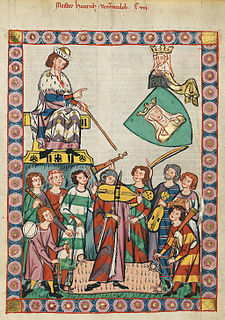
WHeinrich Frauenlob, sometimes known as Henry of Meissen, was a Middle High German poet, a representative of both the Sangspruchdichtung and Minnesang genres. He was one of the most celebrated poets of the late medieval period, venerated and imitated well into the 15th century.
 W
WFriedrich von Hausen was a medieval German poet, one of the earliest of the Minnesingers; born sometime between 1150–60; d. 6 May 1190.
 W
WGottfried von Strassburg is the author of the Middle High German courtly romance Tristan, an adaptation of the 12th-century Tristan and Iseult legend. Gottfried's work is regarded, alongside the Nibelungenlied and Wolfram von Eschenbach's Parzival, as one of the great narrative masterpieces of the German Middle Ages. He is probably also the composer of a small number of surviving lyrics. His work became a source of inspiration for Richard Wagner's opera Tristan und Isolde (1865).
 W
WJohannes Hadlaub is one of the Minnesingers whose works are recorded in Codex Manesse. He was a citizen of Zürich, and is on record as buying a house there in 1302.
 W
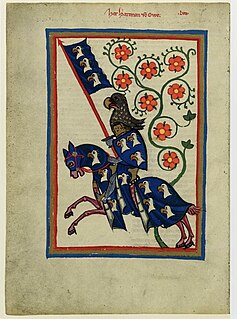
WHartmann von Aue, also known as Hartmann von Ouwe, was a German knight and poet. With his works including Erec, Iwein, Gregorius, and Der arme Heinrich, he introduced the courtly romance into German literature and, with Wolfram von Eschenbach and Gottfried von Strassburg, was one of the three great epic poets of Middle High German literature.
 W
WHawart was a German poet in the tradition of Minnesang. His surviving works focus on both love and politics. His reference in one poem to the Holy Places being in the hands of the heathen places it after the fall of Jerusalem in 1244. In another song he laments the failure of the princes of the Holy Roman Empire to unite behind one emperor, a clear reference to the Great Interregnum (1254–1273).
 W
WHeinrich von Morungen or Henry of Morungen was a German Minnesinger.
 W
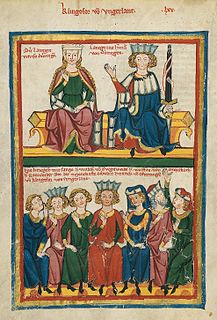
WHeinrich von Ofterdingen is a fabled, quasi-fictional Middle High German lyric poet and Minnesinger mentioned in the 13th century epic of the Sängerkrieg on the Wartburg. The legend was perpetuated by Novalis in his eponymous fragment novel written in 1800 and by E. T. A. Hoffmann in his 1818 novella Der Kampf der Sänger.
 W
WHeinrich von Veldeke is the first writer in the Low Countries known by name, who wrote in a European language other than Latin. He was born in Veldeke, a hamlet in the territory of Spalbeek, which has been a community of Hasselt, Limburg, Belgium, since 1977. The ‘Vel(de)kermolen’, a water mill on the Demer River, is the only remainder of the hamlet. In Limburg, he is celebrated as a writer of Old Limburgish.
 W
WHenry III, called Henry the Illustrious from the House of Wettin was Margrave of Meissen and last Margrave of Lusatia from 1221 until his death; from 1242 also Landgrave of Thuringia.
 W
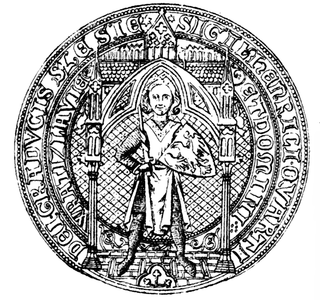
WHenryk IV Probus was a member of the Silesian branch of the royal Polish Piast dynasty. He was Duke of Silesia at Wrocław from 1266, and from also 1288 High Duke of the Polish Seniorate Province of Kraków until his death in 1290.
 W
WHenry VI, a member of the Hohenstaufen dynasty, was King of Germany from 1169 and Holy Roman Emperor from 1191 until his death. From 1194 he was also King of Sicily.
 W
WHenry I, a member of the House of Ascania, was Count of Anhalt from 1212 and the first ruling Anhalt prince from 1218 until his death.
 W
WHugo von Montfort was an Austrian minstrel of the Late Middle Ages.
 W
WKonrad von Würzburg was the chief German poet of the second half of the 13th century.
 W
WDer von Kürenberg or Der Kürenberger was a Middle High German poet and one of the earliest Minnesänger. Fifteen strophes of his songs are preserved in the Codex Manesse and the Budapest Fragment.
 W
WMeinloh von Sevelingen was a 12th Century Minnesänger from Swabia and one of the earliest poets in the tradition.
 W
WNeidhart von Reuental was one of the most famous German minnesingers. He was probably active in the Duchy of Bavaria and then is known to have been a singer at the court of Duke Frederick II of Austria in Vienna. As a minnesinger he was most active from 1210 to at least 1236.
 W
WOswald von Wolkenstein was a poet, composer and diplomat. In his diplomatic capacity, he traveled through much of Europe to as far as Georgia.
 W
WOtto von Botenlauben or Botenlouben, the Count of Henneberg from 1206, was a German minnesinger, Crusader and monastic founder.
 W
WReinmar von Brennenberg was a minnesinger and ministerialis to the Bishop of Regensburg in the 13th century.
 W
WReinmar von Hagenau was a German Minnesänger of the late twelfth century, who composed and performed love-songs in Middle High German He was regarded by his contemporaries as the greatest Minnesänger before Walther von der Vogelweide, a view widely shared by modern scholars.. Although there are uncertainties as to which songs can be reliably attributed to him, a substantial body of his work — over 60 songs — survives. His presentation of courtly love as the unrequited love of a knight for a lady is "the essence of classical Minesang".
 W
WReinmar von Zweter was a Middle High German poet of Spruchdichtung. The iconography in the Manesse Codex suggests that he may have been blind, since he is the only person represented in the manuscript with closed eyes and other people writing. The caption, not shown here, of that miniature refers to him as "Herr" Reinmar, implying that he was a knight and that he became blind in adulthood.
 W
WStadeck was an important family of ministeriales in Styria during the 13th and 14th centuries.
 W
WTannhäuser was a German Minnesinger and poet. Historically, his biography is obscure beyond the poetry, which dates between 1245 and 1265.
 W
WUlrich von Liechtenstein was a German minnesinger and poet of the Middle Ages. He wrote poetry in Middle High German and was author of noted works about how knights and nobles may lead more virtuous lives. Ulrich was a member of a wealthy and influential ministerialis family from Liechtenstein in Styria. He was born about 1200 at Murau in the Duchy of Styria, located in the present-day country of Austria.
 W
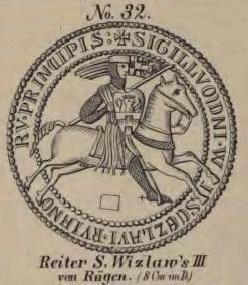
WVitslav III (1265/8–1325), variously called Vislav, Vizlav, Wislaw, Wizlaw and Witslaw in English sources, was the last Slavic ruler of the Danish Principality of Rugia. He is often identified with the author of the Minnesinger Vitslav of the Jenaer Liederhandschrift.
 W
WWalther von der Vogelweide was a Minnesänger, who composed and performed love-songs and political songs ("Sprüche") in Middle High German. Walther has been described as greatest German lyrical poet before Goethe; his hundred or so love-songs are widely regarded as the pinnacle of Minnesang, the medieval German love lyric, and his innovations breathed new life into the tradition of courtly love. He is also the first political poet writing in German, with a considerable body of encomium, satire, invective, and moralising.
 W
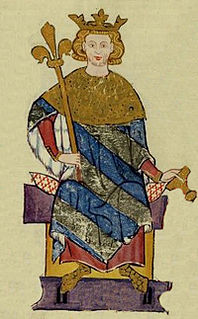
WWenceslaus II Přemyslid was King of Bohemia (1278–1305), Duke of Cracow (1291–1305), and King of Poland (1300–1305).
 W
WWernher von Homberg was a knight in the service Emperor Henry VII, and later of Frederick the Fair. His Minnesang poems are recorded in the Codex Manesse.
 W
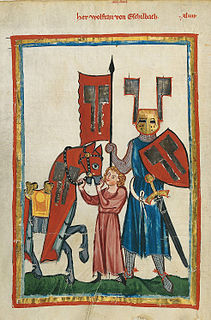
WWolfram von Eschenbach was a German knight, poet and composer, regarded as one of the greatest epic poets of medieval German literature. As a Minnesinger, he also wrote lyric poetry.