 W
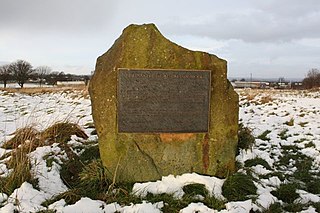
WThe Battle of Adwalton Moor occurred on 30 June 1643 at Adwalton, West Yorkshire, during the First English Civil War. In the battle, the Royalists loyal to King Charles led by the Earl of Newcastle soundly defeated the Parliamentarians commanded by Lord Fairfax.
 W
WThe Battle of Barnet was a decisive engagement in the Wars of the Roses, a dynastic conflict of 15th-century England. The military action, along with the subsequent Battle of Tewkesbury, secured the throne for Edward IV. On 14 April 1471 near Barnet, then a small Hertfordshire town north of London, Edward led the House of York in a fight against the House of Lancaster, which backed Henry VI for the throne. Leading the Lancastrian army was Richard Neville, Earl of Warwick, who played a crucial role in the fate of each king. Historians regard the battle as one of the most important clashes in the Wars of the Roses, since it brought about a decisive turn in the fortunes of the two houses. Edward's victory was followed by 14 years of Yorkist rule over England.
 W
WThe Battle of Blore Heath was a battle in the English Wars of the Roses. It was fought on 23 September 1459, at Blore Heath in Staffordshire. Blore Heath is a sparsely populated area of farmland, two miles east of the town of Market Drayton in Shropshire, and close to the towns of Market Drayton and Loggerheads, Staffordshire.
 W
WThe Battle of Bosworth or Bosworth Field was the last significant battle of the Wars of the Roses, the civil war between the Houses of Lancaster and York that extended across England in the latter half of the 15th century. Fought on 22 August 1485, the battle was won by an alliance of Lancastrians and disaffected Yorkists. Their leader Henry Tudor, Earl of Richmond, became the first English monarch of the Tudor dynasty by his victory and subsequent marriage to a Yorkist princess. His opponent Richard III, the last king of the House of York, was killed during the battle, the last English monarch to die in combat. Historians consider Bosworth Field to mark the end of the Plantagenet dynasty, making it one of the defining moments of English history.
 W
WThe Battle of Boroughbridge was fought on 16 March 1322 in England between a group of rebellious barons and King Edward II, near Boroughbridge, north-west of York. The culmination of a long period of antagonism between the King and Thomas, Earl of Lancaster, his most powerful subject, it resulted in Lancaster's defeat and execution. This allowed Edward to re-establish royal authority, and hold on to power for almost five more years.
 W
WThe Battle of Braddock Down was a battle of the south-western campaign of the First English Civil War. It was fought on open ground in Cornwall, on 19 January 1643. An apparently easy victory for the Royalists under Sir Ralph Hopton secured Cornwall for King Charles and confirmed Hopton's reputation as a commander. Hopton also gained respect for the mercy shown to his foe, of whom 1,500 were captured during and after the battle. The precise location of the battlefield is a matter of dispute, though English Heritage believe it to be within parkland at Boconnoc.
 W
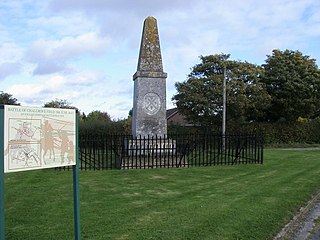
WThe Battle of Chalgrove Field took place on 18 June 1643, during the First English Civil War, near Chalgrove, Oxfordshire. It is now best remembered for the death of John Hampden, who was wounded in the shoulder during the battle and died six days later.
 W
WThe Battle of Cheriton of 29 March 1644 was an important Parliamentarian victory during the First English Civil War. Sir William Waller's "Army of the Southern Association" defeated a Royalist force jointly commanded by the Earl of Forth and Sir Ralph Hopton. Defeat ended Royalist hopes of retaking South East England and forced them onto the defensive for the rest of 1644.
 W
WThe Battle of Cropredy Bridge was fought on 29 June 1644 near Banbury, Oxfordshire during the First English Civil War. In the engagement, Sir William Waller and the Parliamentarian army failed to capture King Charles.
 W
WThe Battle of Edgehill was a pitched battle of the First English Civil War. It was fought near Edge Hill and Kineton in southern Warwickshire on Sunday, 23 October 1642.
 W
WThe Battle of Evesham was one of the two main battles of 13th century England's Second Barons' War. It marked the defeat of Simon de Montfort, Earl of Leicester, and the rebellious barons by the future King Edward I, who led the forces of his father, King Henry III. It took place on 4 August 1265, near the town of Evesham, Worcestershire.
 W
WThe Battle of Flodden, Flodden Field, or occasionally Branxton, was a battle fought on 9 September 1513 during the War of the League of Cambrai between the Kingdom of England and the Kingdom of Scotland, resulting in an English victory. The battle was fought near Branxton in the county of Northumberland in northern England, between an invading Scots army under King James IV and an English army commanded by the Earl of Surrey. In terms of troop numbers, it was the largest battle fought between the two kingdoms.
 W
WThe Battle of Halidon Hill took place on 19 July 1333 when a Scottish army under Sir Archibald Douglas attacked an English army commanded by King Edward III of England and was heavily defeated. The year before, Edward Balliol had seized the Scottish Crown from five-year-old David II, surreptitiously supported by Edward III. This marked the start of the Second War of Scottish Independence. Balliol was shortly expelled from Scotland by a popular uprising, which Edward III used as a casus belli, invading Scotland in 1333. The immediate target was the strategically important border town of Berwick-upon-Tweed, which the English besieged in March.
 W
WThe Battle of Hastings was fought on 14 October 1066 between the Norman-French army of William, the Duke of Normandy, and an English army under the Anglo-Saxon King Harold Godwinson, beginning the Norman conquest of England. It took place approximately 7 mi (11 km) northwest of Hastings, close to the present-day town of Battle, East Sussex, and was a decisive Norman victory.
 W
WSenlac Hill is the generally accepted location in which Harold Godwinson deployed his army for the Battle of Hastings on 14 October 1066. It is located near what is now the town of Battle, East Sussex. The name Senlac was popularised by the Victorian historian E.A. Freeman, based solely on a description of the battle by the Anglo-Norman chronicler Orderic Vitalis. Freeman went on to suggest that the Normans nicknamed the area Blood lake as a pun on the English Sand lake.
 W
WThe Battle of Hopton Heath was a battle of the First English Civil War, fought on Sunday 19 March 1643 between Parliamentarian forces led by Sir John Gell, 1st Baronet and Sir William Brereton and a Royalist force under Spencer Compton, 2nd Earl of Northampton.
 W
WThe Battle of Langport was a Parliamentarian victory late in the First English Civil War which destroyed the last Royalist field army and gave Parliament control of the West of England, which had hitherto been a major source of manpower, raw materials and imports for the Royalists. The battle took place on 10 July 1645 near the small town of Langport, which lies south of Bristol.
 W
WThe First English Civil War battle of Lansdowne, or Lansdown, was fought on 5 July 1643, at Lansdowne Hill, near Bath, Somerset, England. Although the Royalists under Lord Hopton forced the Parliamentarians under Sir William Waller to retreat from their hilltop position, they suffered so many casualties themselves and were left so disordered and short of ammunition that an injured Hopton was forced to retire.
 W
WThe Battle of Lewes was one of two main battles of the conflict known as the Second Barons' War. It took place at Lewes in Sussex, on 14 May 1264. It marked the high point of the career of Simon de Montfort, 6th Earl of Leicester, and made him the "uncrowned King of England". Henry III left the safety of Lewes Castle and St. Pancras Priory to engage the barons in battle and was initially successful, his son Prince Edward routing part of the baronial army with a cavalry charge. However, Edward pursued his quarry off the battlefield and left Henry's men exposed. Henry was forced to launch an infantry attack up Offham Hill where he was defeated by the barons' men defending the hilltop. The royalists fled back to the castle and priory and the King was forced to sign the Mise of Lewes, ceding many of his powers to Montfort.
 W
WThe Battle of Maldon took place on 11 August 991 AD near Maldon beside the River Blackwater in Essex, England, during the reign of Æthelred the Unready. Earl Byrhtnoth and his thegns led the English against a Viking invasion. The battle ended in an Anglo-Saxon defeat. After the battle Archbishop Sigeric of Canterbury and the aldermen of the south-western provinces advised King Æthelred to buy off the Vikings rather than continue the armed struggle. The result was a payment of 10,000 Roman pounds (3,300 kg) of silver, the first example of Danegeld in England.
 W
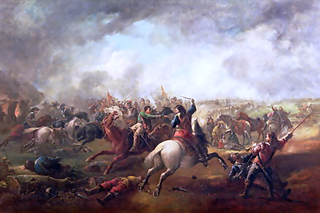
WThe Battle of Marston Moor was fought on 2 July 1644, during the First English Civil War of 1642–1646. The combined forces of the English Parliamentarians under Lord Fairfax and the Earl of Manchester and the Scottish Covenanters under the Earl of Leven defeated the Royalists commanded by Prince Rupert of the Rhine and the Marquess of Newcastle.
 W
WThe Battle of Nantwich was fought on 25 January 1644 in Cheshire during the First English Civil War. In the battle, Sir Thomas Fairfax in command of a Parliamentarian relief force defeated Lord Byron and the Royalists.
 W
WThe Battle of Naseby took place on 14 June 1645 during the First English Civil War, near the village of Naseby in Northamptonshire. The Parliamentarian New Model Army, commanded by Sir Thomas Fairfax and Oliver Cromwell, destroyed the main Royalist army under Charles I and Prince Rupert. Defeat ended any real hope of Royalist victory, although Charles did not finally surrender until May 1646.
 W
WThe Battle of Neville's Cross took place during the Second War of Scottish Independence on 17 October 1346, half a mile to the west of Durham, England. An invading Scottish army of 12,000 led by King David II was defeated with heavy loss by an English army of approximately 6,000–7,000 men led by Ralph Neville, Lord Neville. The battle was named after an Anglo-Saxon stone cross that stood on the hill where the Scots made their stand. After the victory, Neville paid to have a new cross erected to commemorate the day.
 W
WThe Battle of Newburn, also known as Battle of Newburn Ford, took place on 28 August 1640, during the Second Bishops' War. It was fought at Newburn, a village just outside Newcastle, situated at a ford over the River Tyne.
 W
WThe First Battle of Newbury was a battle of the First English Civil War that was fought on 20 September 1643 between a Royalist army, under the personal command of King Charles, and a Parliamentarian force led by the Earl of Essex. Following a year of Royalist successes in which they took Banbury, Oxford and Reading without conflict before storming Bristol, the Parliamentarians were left without an effective army in the west of England. When Charles laid siege to Gloucester, Parliament was forced to muster a force under Essex with which to beat Charles' forces off. After a long march, Essex surprised the Royalists and forced them away from Gloucester before beginning a retreat to London. Charles rallied his forces and pursued Essex, overtaking the Parliamentarian army at Newbury and forcing them to march past the Royalist force to continue their retreat.
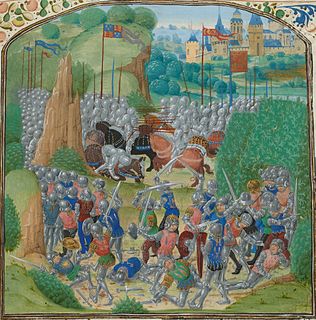
WThe Battle of Northampton was fought on 10 July 1460 near the River Nene, Northamptonshire. It was a major battle of the Wars of the Roses. The opposing forces were an army led by nobles loyal to King Henry VI of the House of Lancaster, his Queen Margaret of Anjou and their seven-year-old son Edward, Prince of Wales on one side, and the army of Edward, Earl of March and Warwick the Kingmaker on the other. The battle was the first in which artillery was used in England.
 W
WThe Battle of Otterburn took place according to Scottish sources on 5 August 1388, or 19 August according to English sources, as part of the continuing border skirmishes between the Scots and English.
 W
WThe Battle of Roundway Down was fought on 13 July 1643 near Devizes, in Wiltshire during the First English Civil War. Despite being outnumbered and exhausted after riding overnight from Oxford, a Royalist cavalry force under Lord Wilmot won a crushing victory over the Parliamentarian Army of the West under Sir William Waller.
 W
WThe Battle of Rowton Heath, also known as the Battle of Rowton Moor, occurred on 24 September 1645 during the English Civil War. Fought by the Parliamentarians, commanded by Sydnam Poyntz, and the Royalists under the personal command of King Charles I, it was a significant defeat for the Royalists, with heavy losses and Charles prevented from relieving the siege of Chester.
 W
WThe Battle of Sedgemoor was the last and decisive engagement between the Kingdom of England and rebels led by the Duke of Monmouth during the Monmouth rebellion, fought on 6 July 1685, and took place at Westonzoyland near Bridgwater in Somerset, England, resulting in a victory for the English army.
 W
WThe Battle of Shrewsbury was a battle fought on 21 July 1403, waged between an army led by the Lancastrian King Henry IV and a rebel army led by Henry "Harry Hotspur" Percy from Northumberland. The battle, the first in which English archers fought each other on English soil, reaffirmed the effectiveness of the longbow and ended the Percy challenge to King Henry IV of England.
 W
WThe Battle of Solway Moss took place on Solway Moss near the River Esk on the English side of the Anglo-Scottish border in November 1542 between English and Scottish forces.
 W
WThe Battle of Stamford Bridge took place at the village of Stamford Bridge, East Riding of Yorkshire, in England, on 25 September 1066, between an English army under King Harold Godwinson and an invading Norwegian force led by King Harald Hardrada and the English king's brother Tostig Godwinson. After a bloody battle, both Hardrada and Tostig, along with most of the Norwegians, were killed. Although Harold Godwinson repelled the Norwegian invaders, his army was defeated by the Normans at Hastings less than three weeks later. The battle has traditionally been presented as symbolising the end of the Viking Age, although major Scandinavian campaigns in Britain and Ireland occurred in the following decades, such as those of King Sweyn Estrithson of Denmark in 1069–1070 and King Magnus Barefoot of Norway in 1098 and 1102–1103.
 W
WThe Battle of the Standard, sometimes called the Battle of Northallerton, took place on 22 August 1138 on Cowton Moor near Northallerton in Yorkshire. English forces under William of Aumale repelled a Scottish army led by King David I of Scotland.
 W
WThe Battle of Stoke Field on 16 June 1487 may be considered the last battle of the Wars of the Roses, since it was the last major engagement between contenders for the throne whose claims derived from descent from the houses of Lancaster and York respectively. The Battle of Bosworth Field, two years previously, had established King Henry VII on the throne, ending the last period of Yorkist rule and initiating that of the Tudors. The Battle of Stoke Field was the decisive engagement in an attempt by leading Yorkists to unseat him in favour of the pretender Lambert Simnel.
 W
WThe Battle of Stow-on-the-Wold took place during the First English Civil War. It was a Parliamentarian victory by detachments of the New Model Army over the last Royalist field army.
 W
WThe Battle of Stratton, also known as the Battle of Stamford Hill, took place on 16 May 1643, during the First English Civil War. In the battle, the Royalists destroyed Parliament's field army in Devon and Cornwall.
 W
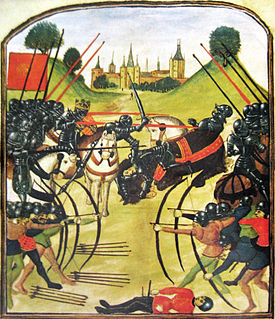
WThe Battle of Tewkesbury, which took place on 4 May 1471, was one of the decisive battles of the Wars of the Roses in England. The forces loyal to the House of Lancaster were completely defeated by those of the rival House of York under their monarch, King Edward IV. The Lancastrian heir to the throne, Edward, Prince of Wales, and many prominent Lancastrian nobles were killed during the battle or executed. The Lancastrian king, Henry VI of England, who was a prisoner in the Tower of London, died or was murdered shortly after the battle. Tewkesbury restored political stability to England until the death of Edward IV in 1483.
 W
WThe Battle of Towton was fought on 29 March 1461 during the English Wars of the Roses, near the village of Towton in Yorkshire. It was "probably the largest and bloodiest battle ever fought on English soil". An estimated 50,000 soldiers fought for hours during a snowstorm on that day, which was Palm Sunday. It brought about a change of monarchs in England, with Edward IV displacing Henry VI, establishing the House of York on the English throne and driving the incumbent House of Lancaster and its key supporters out of the country.
 W
WThe Battle of Winceby took place on 11 October 1643 during the First English Civil War near the village of Winceby, Lincolnshire. In the battle, a Royalist relieving force under the command of Sir William Widdrington was defeated by the Parliamentarian cavalry of the Earl of Manchester.
 W
WThe Battle of Worcester took place on 3 September 1651 at Worcester, England, and was the final battle of the English Civil War, which began in 1642. Oliver Cromwell's Parliamentarian New Model Army, 28,000 strong, defeated King Charles II's 16,000 Royalists, of whom the vast majority were Scottish. The Royalist forces took up defensive positions in and around the city of Worcester. The area of the battle was bisected by the River Severn, with the River Teme forming an additional obstacle to the south-west of Worcester. Cromwell divided his army into two main sections, divided by the Severn, in order to attack from both the east and south-west. There was fierce fighting at river crossing points and two dangerous sorties by the Royalists against the eastern Parliamentary force were beaten back. Following the storming of a major redoubt to the east of the city, the Parliamentarians entered Worcester and organised Royalist resistance collapsed. Charles II was able to escape capture.