 W
WThe Bahe Formation is a Late Miocene geological formation in Shaanxi, China. It has "a complex lithology of predominantly orange-yellow conglomerates, sandstones, tan-yellow sandy mudstones, and tan-red mudstones." The main fossil locality is in the Jiulaopo region on the left bank of the Bahe River in Lantian.
WThe Beipiao Formation contains coal measures dated to the Early Jurassic period. Its mainly located in Xinglong County, Hebei Province
WThe Chuanjie Formation, is a geological formation in Yunnan, China. It dates back to the Middle Jurassic. It was formerly referred to as being the lower member of the "Upper Lufeng" as opposed to the underlying "Lower Lufeng" now referred to as the Lufeng Formation. Tracks of theropods and sauropods, as well as thyreophorans are known from the formation.
WThe Dalangshan Formation, also referred to as the Dalangshan Group is a geological formation in the Sanshui District of Guangdong Province, China, the strata of which date back to the Late Cretaceous period.
 W
WThe Dengying Formation is an upper Ediacaran fossiliferous geologic formation found in South China. It was deposited on a shallow marine carbonate platform.
 W
WThe Djadochta Formation is a geological formation situated in central Asia, dating from the Late Cretaceous Period. Laid down in the early Campanian, possibly starting in the latest Santonian, it is dated somewhat uncertainly at about 75-71 mya. The type locality are the famous "Flaming Cliffs", locally known as Bayanzag or Ulaan-Ereg.
 W
WThe Doushantuo Formation is a fossil Lagerstätte in Weng'an County, Guizhou Province, China that is notable for being one of the oldest beds to contain minutely preserved microfossils, phosphatic fossils that are so characteristic they have given their name to "Doushantuo type preservation". The formation is of particular interest because a part of it appears to cover the boundary between the enigmatic organisms of the Ediacaran geological period and the more familiar fauna of the Cambrian explosion where lifeforms recognizable as ancestors of later and recent lifeforms first emerged. Taken as a whole, the Doushantuo Formation ranges from about 635 Ma at its base to about 551 Ma at its top, predating by perhaps five Ma the earliest of the 'classical' Ediacaran faunas from Mistaken Point on the Avalon peninsula of Newfoundland, and recording conditions up to a good forty to fifty million years before the Cambrian explosion.
WThe Ejinhoro Formation is a geological formation in Inner Mongolia, north China, whose strata date back to the Early Cretaceous period (Aptian/Albian age.
WThe Ermaying Formation is a sedimentary succession of Anisian age. It is found in the Shaanxi Province of China. It is composed of an up to 600 m thick sequence of mudstone and sandstone. It is famous for its fossils of tetrapods.
WThe Feitianshan Formation is a geological formation in China. It dates back to the Early Cretaceous. Among the known ichnofossils are footprints of dinosaurs.
WThe Fengjiahe Formation is a geological formation in China. It dates back to the Early Jurassic. The formation is up to 1500 metres thick and consists of "purple-red mudstone and argillaceous siltstone interbedded with gray-green and yellow-green quartz sandstone and feldspathic quartz sandstone"
WThe Gaogou Formation is a Late Cretaceous (Cenomanian-Turonian) geologic formation in China. Fossil dinosaur eggs, the caenagnathid Beibeilong, and the titanosaur Baotianmansaurus have been reported from the formation.
WThe Guanling Formation is a Middle Triassic geologic formation in southwestern China. The formation encompasses two members. The first member is primarily calcareous mudstone and dolomite, indicative of a coastal environment. The second member is a thicker marine sequence of dark micritic limestone with some dolomite. Two distinct fossil assemblages are found in the second member. The older Luoping biota preserves abundant arthropods along with fossils from other invertebrates and vertebrates, which are rare but well-preserved. The slightly younger Panxian fauna has a more diverse and common assortment of marine reptiles such as sauropterygians.
WThe Haifanggou Formation is a fossil-bearing rock deposit located near Daohugou village of Ningcheng County, in Inner Mongolia, northeastern China.
WThe Hekou Group is a geological group in Gansu Province, China. It is Early Cretaceous in age. Dinosaur body fossils have also been recovered from the Hekou Group, including the iguanodont Lanzhousaurus and the titanosaurs Daxiatitan, Huanghetitan and Yongjinglong, and the nodosaur Taohelong. Fossil eggs are rare, but one oogenus, Polyclonoolithus, was discovered in the Hekou Group. The group spans the Valanginian to Albian and can be subdivided into four formations. Fossil pterosaur tracks have been recovered.
WThe Huiquanpu Formation is a geological formation in Shanxi and Hebei provinces, China, whose strata date back to the Late Cretaceous period. It predominantly consists of purple-red mudstone, with subordinate grey-white sandy conglomerates.
WThe Iren Dabasu Formation is a Late Cretaceous (Cenomanian) geologic formation in the Iren Nor region of Inner Mongolia. Dinosaur remains diagnostic to the genus level are among the fossils that have been recovered from the formation. The formation was first described and defined by Henry Fairfield Osborn in 1922 and it is located in the Iren Nor region of China.
 W
WThe Jehol Biota includes all the living organisms – the ecosystem – of northeastern China between 133 and 120 million years ago. This is the Lower Cretaceous ecosystem which left fossils in the Yixian Formation and Jiufotang Formation. These deposits are composed of layers of tephra and sediment. It is also believed to have left fossils in the Sinuiju series of North Korea. The ecosystem in the Lower Cretaceous was dominated by wetlands and numerous lakes. Rainfall was seasonal, alternating between semiarid and mesic conditions. The climate was temperate. The Jehol ecosystem was interrupted periodically by ash eruptions from volcanoes to the west. The word "Jehol" is a historical transcription of the former Rehe Province.
WThe Jingchuan Formation is a Barremian geologic formation in China. Various dinosaur fossils and tracks have been reported from the formation.
WThe Jiufotang Formation is an Early Cretaceous geological formation in Chaoyang, Liaoning which has yielded fossils of feathered dinosaurs, primitive birds, pterosaurs, and other organisms. It is a member of the Jehol group. The exact age of the Jiufotang has been debated for years, with estimates ranging from the Late Jurassic to the Early Cretaceous. He et al. (2004) used argon - isotope radiometry to confirm biostratigraphic age estimates. They confirmed an Early Cretaceous, Aptian age for the Jiufotang Formation, 120.3 +/-0.7 million years ago. Fossils of Microraptor and Jeholornis are from the Jiufotang.
WThe Liangtoutang Formation, also referred to as the Laijia Formation is a geological formation located in Zhejiang, China. Its strata date back to the Albian to Cenomanian stages of the Cretaceous period. The lithology primarily consists of red sandstone.
WThe Lianmuqin Formation, also transcribed as Lianmugin Formation, is an Early Cretaceous geologic formation composed of "interbedded red green and yellow variegated mudstones and siltstones". Dinosaur remains have been recovered from it.
WThe Lufeng Formation is a Lower Jurassic sedimentary rock formation found in Yunnan, China. It has two units: the lower Dull Purplish Beds/Shawan Member are of Hettangian age, and Dark Red Beds/Zhangjia'ao Member are of Sinemurian age. It is known for its fossils of early dinosaurs. The Dull Purplish Beds have yielded the possible therizinosaur Eshanosaurus, the possible theropod Lukousaurus, and the "prosauropods" "Gyposaurus" sinensis, Lufengosaurus, Jingshanosaurus, and Yunnanosaurus. Dinosaurs discovered in the Dark Red Beds include the theropod Sinosaurus triassicus, the "prosauropods" "Gyposaurus", Lufengosaurus, and Yunnanosaurus, indeterminate remains of sauropods, and the early armored dinosaurs Bienosaurus and Tatisaurus.
WThe Luohandong Formation is an Early Cretaceous geologic formation of the Ordos Basin in Inner Mongolia, China. The formation was initially dated to the earliest Cretaceous; Valanginian to Barremian, but later dating established an Aptian to Albian age. Dinosaur remains are among the fossils that have been recovered from the formation. Pterosaur fossils have also been recovered from the formation.
 W
WThe Majiacun Formation is a Santonian to Coniacian geologic formation in China. Dinosaur remains are among the fossils that have been recovered from the formation.
 W
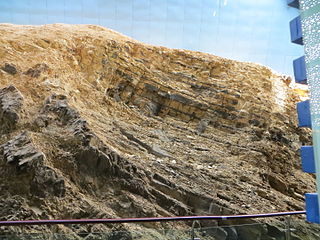
WThe Maotianshan Shales are a series of Early Cambrian deposits in the Chiungchussu Formation, famous for their Konservat Lagerstätten, deposits known for the exceptional preservation of fossilized organisms or traces. The Maotianshan Shales form one of some forty Cambrian fossil locations worldwide exhibiting exquisite preservation of rarely preserved, non-mineralized soft tissue, comparable to the fossils of the Burgess Shale. They take their name from Maotianshan Hill in Chengjiang County, Yunnan Province, China.
WThe Nanchao Formation is a Late Cretaceous geologic formation in China. Fossil ornithopod tracks have been reported from the formation. Embyros of therizinosaurs are known from the formation
WThe Nanxiong Formation is a Late Cretaceous geologic formation in Guangdong Province. Dinosaur remains are among the fossils that have been recovered from the formation. It consists of continental siliciclastic red beds, with fauna which similar to that of the Nemegt Formation. It has been dated about 66.7 ± 0.3 million years ago. It is the lowest unit of the Nanxiong Basin, a small graben created during Mesozoic rifting. Buck et al. state that it overlies Jurassic granite basement, and is conformably overlain by the Shanghu Formation. Alternative stratigraphic schemes for the Nanxiong basin have been proposed, one of which refers to the Nanxiong succession as the Nanxiong Group, and dividing it into the Yuanfu, Zhutian and Zhenshui formations, and overlying the Albian to Turonian Changba Formation.
WThe Qigu Formation is a Late Jurassic (Oxfordian) geologic formation in the Southern Junggar Basin in China. Indeterminate Dinosaur remains are among the fossils that have been recovered from the formation, including theropod teeth and a fibula. a stegosaur dorsal vertebra and a Eusauropod tooth. Xinjiangtitan was erroneously thought to be from this formation, but it is actually from the older Qiketai Formation, which is in a different basin. The term "Qigu Formation" is also used to sediments of equivalent age in the Turpan Basin, but this might better be treated as a separate formation. It is laterally equivalent to the Shishugou Formation.
WThe Qingshan Group is a geological group in Shandong, China, whose strata date back to the Barremian to Albian stages of the Early Cretaceous. The group contains the Doushan Formation. Dinosaur remains are among the fossils that have been recovered from the formation.
 W
WThe Qiupa Formation is a Late Cretaceous Maastrichtian geologic formation in Henan Province, central China. It is rich in dinosaur eggs and bones, such as those of carnivorous and herbivorous dinosaurs. The Qiupa Formation is considered to be Late Maastrichtian in age, about 72 million and 66 million years ago.
WThe Quxian Formation is a Santonian to Campanian geologic formation in China. Fossil dinosaur eggs have been reported from the formation. It is a unit of the Qujiang Group and dates to the Santonian through early Campanian.
 W
WThe Shaximiao Formation is a Middle to Late Jurassic geological formation in Sichuan, China, most notable for the wealth of dinosaurs fossils that have been excavated from its strata. The Shaximiao Formation is exposed in and around the small township of Dashanpu, situated seven kilometres north-east from Sichuan's third largest city, Zigong, in the Da'an District.
WThe Shishugou Formation is a geological formation in Xinjiang, China.
WThe Subashi Formation is a Late Cretaceous formation from the Xinjiang Autonomous Region of western China. Initially described by Dong Zhiming in 1977, the formation contains remains of Tarbosaurus which were initially described as a separate taxon Shanshanosaurus huoyanshanensis. Remains of a sauropod, likely Nemegtosaurus, and a hadrosaurid, likely Jaxartosaurus, have also been found.
WThe Sunjiawan Formation is a geological formation in Liaoning, China, with strata possibly dating back to the early Late Cretaceous, specifically the Cenomanian. Dinosaur remains are among the fossils that have been recovered from the formation. It forms part of the same geological sequence as the older and underlying Yixian Formation and Jiufotang Formation. It primarily consists of variegated conglomerates with rare intercalations of thin bedded sandstones, siltstones and mudstones.
WThe Tiaojishan Formation is a geological formation in Hebei and Liaoning, People's Republic of China, dating to the middle-late Jurassic period. It is known for its exceptionally preserved fossils, including those of plants, insects and vertebrates. It is made up mainly of pyroclastic rock interspersed with basic volcanic and sedimentary rocks. Previously, the Tiaojishan Formation was grouped together with the underlying Haifanggou Formation as a single "Lanqi Formation." Most researchers now agree that the Daohugou Bed, of formerly controversial dating, is a part of the Tiaojishan formation. The Tiaojishan Formation forms a key part of the Yanliao Biota assemblage.
WThe Tongfosi Formation is a Late Cretaceous (Cenomanian) geologic formation of the Yanji Group in China. Fossil ornithopod tracks of iguanodontids and theropods have been reported from the fluvial sandstones of the formation.
WThe Tuchengzi Formation is a geological formation in China whose strata span the Tithonian to Berriasian ages. Dinosaur fossils, particularly footprints, have been found from the formation.
WThe Ulansuhai Formation is a geological formation in Inner Mongolia, north China. Dinosaur remains are among the fossils that have been recovered from the formation.
WThe Wangshi Group is a geological Group in Shandong, China whose strata date back to the Coniacian to Campanian stages of the Late Cretaceous. Dinosaur remains are among the fossils that have been recovered from the group.
WThe Xiagou Formation is the middle strata of the Xinminbao Group. It is named for its type site in Xiagou, in the Changma Basin of Gansu Province, northwestern China and is considered Early Cretaceous in age. It is known outside the specialized world of Chinese geology as the site of a Lagerstätte in which the fossils were preserved of Gansus yumenensis, the earliest true modern bird.
WThe Xiaguan Formation is a Turonian to Campanian geologic formation in Henan Province of China. Dinosaur remains are among the fossils that have been recovered from the formation.
 W
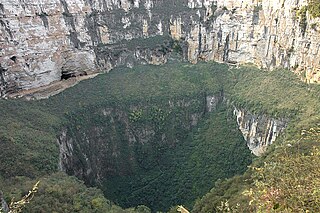
WThe Xiaozhai Tiankeng (小寨天坑), also known as the Heavenly Pit, is the world's deepest sinkhole. It is located in Fengjie County of Chongqing Municipality.
WThe Xinlong Formation is an Early Cretaceous geologic formation in Guangxi, southern China.
WThe Yanan Formation, alternatively spelled the Yan'an Formation is a geological formation in China, it is also alternatively considered a group. The age of the formation is uncertain, with estimates ranging from Toarcian to Bajocian. It is divided up into 5 members, with the designation of Y1 through Y5. Y2, Y3 and Y4 are predominantly dark shales, while Y1 and Y5 are composed of sandstones, coal beds and interbedded mudstones. The depositional environment at the time was when the Ordos Basin formed a large inland lake, surrounded by floodplains. The dark shales have been explored for the potential of producing shale gas. The coal has also been explored for the production of coalbed methane. The formation is also notable for its fossil content, with dinosaur footprints and the remains of the sauropod Lingwulong having been found in the formation.
WThe Yanliao Biota is the name given to an assembly of fossils preserved in northeastern China from the Middle Jurassic to Early Cretaceous. It includes fossils from the Tiaojishan Formation, Lanqi Formation, Jiulongshan Formation and Haifanggou Formation. This spans approximately 199 to 146 million years ago.
WThe Yixian Formation is a geological formation in Jinzhou, Liaoning, People's Republic of China, that spans 11 million years during the early Cretaceous period. It is known for its exquisitely preserved fossils, and is mainly composed of basalts interspersed with siliciclastic sediments.
WThe Zhaoying Formation is a Coniacian geologic formation in Henan Province, China. Fossil dinosaur eggs of Ovaloolithus sp. have been reported from the formation.
WThe Zhumapu Formation is an early Late Cretaceous geologic formation in Shanxi Province, China. The hadrosauroids Yunganglong and Zuoyunlong and the informally named ankylosaur "Jindipelta" have been recovered from this unit.