 W
WThe Adaffa Formation is a Geological formation in Saudi Arabia, and the lowermost unit of the Suqah Group. It dates back to the Campanian of the Late Cretaceous. The lithology consists of sandstone, siltstone and marl, with a basal granitic conglomerate with phosphatic nodules. Also present are ferricrete horizons. It was deposited in marginal marine conditions close to land. Fish, marine reptile and dinosaur remains have been recovered from the formation.
 W
WThe Barun Goyot Formation is a geological formation dating to the Late Cretaceous Period. It is located within and is widely represented in the Gobi Desert Basin, in the Ömnögovi Province of Mongolia.
 W
WThe Bayan Shireh Formation is a geological formation in Mongolia, that dates to the Late Cretaceous period. It was first described and established by Vasiliev et al. 1959.
WThe Alagteeg Formation is a geological formation in Mongolia whose strata date back to the Late Cretaceous. Dinosaur remains are among the fossils that have been recovered from the formation. It predominantly consists of alternating reddish brown mudstone and horizontally laminated sandstone, with ripple cross laminations and rhizoliths. It was first formally defined as a unit by Hasegawa et al in 2008 as a distinct unit from the overlying Djadochta Formation. The environment of deposition is suggested to be fluvial, originating in sandy braided river, floodplain and ephemeral lake depositional environments, as opposed to the desert depositional environment of the Djadochta Formation.
 W
WThe Bissekty Formation is a geologic formation and Lagerstätte which crops out in the Kyzyl Kum desert of Uzbekistan, and dates to the Late Cretaceous Period. Laid down in the mid to late Turonian, it is dated to about 92 to 90 Ma.
 W
WThe Bostobe Formation is a geological formation in Qaraghandy & Qyzylorda, Kazakhastan whose strata date back to the Late Cretaceous.
WThe Dabrazhin Formation preserves dinosaur fossils in Kazakhstan. There are indeterminate remains of sauropods, nodosaurs, ornithomimosaurs, and other reptiles.
 W
WThe Dalangshan Formation, also referred to as the Dalangshan Group is a geological formation in the Sanshui District of Guangdong Province, China, the strata of which date back to the Late Cretaceous period.
 W
WThe Djadochta Formation is a geological formation situated in central Asia, dating from the Late Cretaceous Period. Laid down in the early Campanian, possibly starting in the latest Santonian, it is dated somewhat uncertainly at about 75-71 mya. The type locality are the famous "Flaming Cliffs", locally known as Bayanzag or Ulaan-Ereg.
WThe Eginsai Formation is a geological formation in Kazakhstan whose strata date back to the Late Cretaceous. Dinosaur remains are among the fossils that have been recovered from the formation.
WThe Gaogou Formation is a Late Cretaceous (Cenomanian-Turonian) geologic formation in China. Fossil dinosaur eggs, the caenagnathid Beibeilong, and the titanosaur Baotianmansaurus have been reported from the formation.
WThe Huiquanpu Formation is a geological formation in Shanxi and Hebei provinces, China, whose strata date back to the Late Cretaceous period. It predominantly consists of purple-red mudstone, with subordinate grey-white sandy conglomerates.
 W
WThe Ialovachsk or Yalovach Formation is a Santonian geologic formation in Kyrgyzstan, Tajikistan and Uzbekistan. Fossil dinosaur eggs have been reported from the formation.
WThe Iren Dabasu Formation is a Late Cretaceous (Cenomanian) geologic formation in the Iren Nor region of Inner Mongolia. Dinosaur remains diagnostic to the genus level are among the fossils that have been recovered from the formation. The formation was first described and defined by Henry Fairfield Osborn in 1922 and it is located in the Iren Nor region of China.
WThe Javkhlant Formation is a geological formation in Mongolia whose strata date back to the Late Cretaceous possibly Santonian to Campanian. Ceratopsian, ornithopod and theropod remains been found in the formation. A prominent fossilized therizinosauroid nesting site is also known from the formation.
 W
WThe Jindong Formation is a geological formation located in South Korea. It dates to the Cenomanian stage of the Late Cretaceous, with a maximum depositional age of 99.9 ± 0.7 Ma.
 W
WThe Jobu Formation is a Cretaceous geologic formation of Late Cenomanian age. Dinosaur remains are among the fossils that have been recovered from the formation, although none have yet been referred to a specific genus. The oldest confirmed tyrannosaurid premaxillary tooth was recovered from the Jobu Formation. The mammal Sorlestes is also known from the formation.
 W
WThe Kakanaut Formation is a geological formation in Siberia, whose strata date back to the Late Cretaceous (Maastrichtian). Dinosaur remains are among the fossils that have been recovered from the formation. The youngest remains of Bennettitales in the northern hemisphere, Pterophyllum terechoviae are known from the formation.
 W
WThe Kallakurichi Formation, alternatively spelled as Kallankurichchi or Kallankurichi Formation, is a geological formation of the Ariyalur Group in Tamil Nadu, southern India whose strata date back to the Maastrichtian stage of the Late Cretaceous. Dinosaur eggs of Megaloolithus cylindricus are among the fossils that have been recovered from the sandy limestones of the formation.
WThe Khodzhakul Formation is a Cenomanian aged geologic formation in Uzbekistan. Dinosaur remains are among the fossils that have been recovered from the formation. As well as those of Mammals. It is part of the same stratigraphic succession as the overlying Bissekty Formation.
WThe Lameta Formation, also known as the Infratrappean Beds is a sedimentary rock formation found in Madhya Pradesh, Gujarat, and Maharashtra, India. It is of Maastrichtian age, and is notable for its dinosaur fossils. Many dubious names have been created for isolated bones, but several genera of dinosaurs from these rocks are well-supported, including the titanosaur sauropod Isisaurus and the abelisaurs Indosaurus, Indosuchus, Laevisuchus, and Rajasaurus. As well as mammals, snakes and other fossils.
 W
WThe Majiacun Formation is a Santonian to Coniacian geologic formation in China. Dinosaur remains are among the fossils that have been recovered from the formation.
WThe Manrak Formation is a Campanian geologic formation in Kazakhstan. Fossil dinosaur eggs have been reported from the formation.
 W
WThe Mishash Formation is a Late Cretaceous (Campanian-Maastrichtian) geologic formation in Israel. The formation is correlated with the Duwi Formation of Egypt and the Amman and Ruseifa Formations of Jordan. Mosasaur fossils assigned to Prognathodon currii and pterosaur fossils have been recovered from the formation.
WThe Nanchao Formation is a Late Cretaceous geologic formation in China. Fossil ornithopod tracks have been reported from the formation. Embyros of therizinosaurs are known from the formation
WThe Nanxiong Formation is a Late Cretaceous geologic formation in Guangdong Province. Dinosaur remains are among the fossils that have been recovered from the formation. It consists of continental siliciclastic red beds, with fauna which similar to that of the Nemegt Formation. It has been dated about 66.7 ± 0.3 million years ago. It is the lowest unit of the Nanxiong Basin, a small graben created during Mesozoic rifting. Buck et al. state that it overlies Jurassic granite basement, and is conformably overlain by the Shanghu Formation. Alternative stratigraphic schemes for the Nanxiong basin have been proposed, one of which refers to the Nanxiong succession as the Nanxiong Group, and dividing it into the Yuanfu, Zhutian and Zhenshui formations, and overlying the Albian to Turonian Changba Formation.
 W
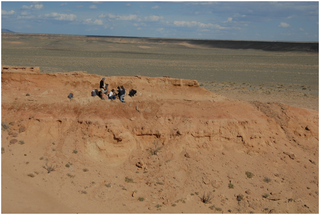
WThe Nemegt Formation is a geological formation in the Gobi Desert of Mongolia, dating to the Late Cretaceous. The formation consists of river channel sediments and contains fossils of fish, turtles, crocodilians, and a diverse fauna of dinosaurs, including birds.
WThe Nichkesaisk or Nichkesai Formation is an early Campanian geologic formation in Kyrgyzstan. Fossil dinosaur eggs have been reported from the formation.
 W
WThe Qiupa Formation is a Late Cretaceous Maastrichtian geologic formation in Henan Province, central China. It is rich in dinosaur eggs and bones, such as those of carnivorous and herbivorous dinosaurs. The Qiupa Formation is considered to be Late Maastrichtian in age, about 72 million and 66 million years ago.
WThe Quxian Formation is a Santonian to Campanian geologic formation in China. Fossil dinosaur eggs have been reported from the formation. It is a unit of the Qujiang Group and dates to the Santonian through early Campanian.
WThe Ryugase Group is a geological formation on Sakhalin Island in far eastern Russia whose strata date back to the Late Cretaceous.
WThe Seonso Conglomerate is a Mesozoic geologic formation in South Korea. Fossil of Asprosaurus, Koreanosaurus and some dinosaur eggs have been reported from the formation.
WThe Subashi Formation is a Late Cretaceous formation from the Xinjiang Autonomous Region of western China. Initially described by Dong Zhiming in 1977, the formation contains remains of Tarbosaurus which were initially described as a separate taxon Shanshanosaurus huoyanshanensis. Remains of a sauropod, likely Nemegtosaurus, and a hadrosaurid, likely Jaxartosaurus, have also been found.
WThe Sunjiawan Formation is a geological formation in Liaoning, China, with strata possibly dating back to the early Late Cretaceous, specifically the Cenomanian. Dinosaur remains are among the fossils that have been recovered from the formation. It forms part of the same geological sequence as the older and underlying Yixian Formation and Jiufotang Formation. It primarily consists of variegated conglomerates with rare intercalations of thin bedded sandstones, siltstones and mudstones.
WThe Tongfosi Formation is a Late Cretaceous (Cenomanian) geologic formation of the Yanji Group in China. Fossil ornithopod tracks of iguanodontids and theropods have been reported from the fluvial sandstones of the formation.
WThe Trichinopoly Group is a geological formation in India whose strata date back to the Late Cretaceous. It lies between the Ootatoor and Ariyalur Groups. It is broad in its southern extremity but thins as it gradually proceeds northwards as it ultimately meets the Ariyalur Group. Dinosaur remains are among the fossils that have been recovered from the formation.
WThe Udurchukan Formation is a geological formation located in Amur Region, Far East Russia. Based on palynomorphs such as Wodehouseia spinata the Udurchukan is considered of Maastrichtian age of the Late Cretaceous, during the Cretaceous Period.
WThe Uhangri Formation, located at the Uhangri Dinosaur Fossil Site, is a geological formation from which fossil pterosaur tracks have been recovered near Haenam-eup, Jeollanam-do, South Korea.
WThe Ulansuhai Formation is a geological formation in Inner Mongolia, north China. Dinosaur remains are among the fossils that have been recovered from the formation.
WThe Wangshi Group is a geological Group in Shandong, China whose strata date back to the Coniacian to Campanian stages of the Late Cretaceous. Dinosaur remains are among the fossils that have been recovered from the group.
WThe Xiaguan Formation is a Turonian to Campanian geologic formation in Henan Province of China. Dinosaur remains are among the fossils that have been recovered from the formation.
WThe Zhaoying Formation is a Coniacian geologic formation in Henan Province, China. Fossil dinosaur eggs of Ovaloolithus sp. have been reported from the formation.
WThe Zhirkindek Formation is a Late Cretaceous geologic formation in Kazakhstan. The primary lithology is sand with interbeds of clay and silt, and represents a coastal to coastal marine environment. The formation has produced numerous fossils, including Lindholmemydid and Trionychid cryptodires, indeterminate remains of dinosaurs and an indeterminate species of pterosaur Azhdarcho.
WThe Zhumapu Formation is an early Late Cretaceous geologic formation in Shanxi Province, China. The hadrosauroids Yunganglong and Zuoyunlong and the informally named ankylosaur "Jindipelta" have been recovered from this unit.