 W
WPolitics of Madagascar takes place in a framework of a semi-presidential representative democratic republic, whereby the President of Madagascar is head of state and the Prime Minister of Madagascar is head of government, and of a pluriform multi-party system. Executive power is exercised by the government. Legislative power is vested in both the government and the Senate and the National Assembly. The Judiciary is independent of the executive and the legislature.
 W
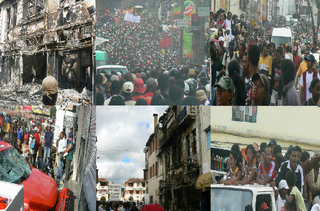
WThe 2009 Malagasy political crisis began on 26 January 2009 with the political opposition movement led by Antananarivo mayor Andry Rajoelina, which sought to oust President Marc Ravalomanana from the presidency. The crisis reached its climax on 21 March 2009 when Andry Rajoelina was declared the president of the High Transitional Authority of Madagascar, five days after Ravalomanana transferred his power to a military council and fled to South Africa.
WThe High Transitional Authority was a provisional executive body that came to power in Madagascar following the coup that forced Marc Ravalomanana to leave the country on March 17, 2009 as a result of the 2009 Malagasy protests. It was headed by Andry Rajoelina, who appointed members to the body weeks prior to the handing of executive authority from Ravalomanana to the military, which subsequently gave the authority over to the High Transitional Authority.
WHuman rights in Madagascar are protected under the country's constitution. However the extent to which such rights are reflected in practice, is subject to debate. The 2009 Human Rights Report by the United States Department of State noted concerns regarding the suspension of democratic electoral processes as the result of recent political unrest. Furthermore, reports of corruption, arbitrary arrest and child labor highlight the prevalence of human rights issues in the country.
 W
WKolo Christopher Laurent Roger, commonly known as Roger Kolo, was Prime Minister of Madagascar from April 2014 to January 2015.
 W
WLesbian, gay, bisexual, and transgender (LGBT) persons in Madagascar face legal challenges not experienced by non-LGBT residents.
 W
WThe Malagasy passport is issued to citizens of Madagascar for international travel.
WThe Parliament of Madagascar has two chambers:The National Assembly has 151 members, elected for five-year terms in single-member and two-member constituencies The Senate has 33 members. 22 are elected, one from each district of Madagascar, and 11 more are appointed by the President, all for five-year terms.
WMinister of Economy and Finance is the person in charge of the Ministry of Economy and Finance of Madagascar.
WMinister of Foreign Affairs of the Republic of Madagascar is a government minister in charge of the Ministry of Foreign Affairs of Madagascar, responsible for conducting foreign relations of the country.
WList of Presidents of the National Assembly of Madagascar.
WThe Presidents of the Senate of Madagascar
 W
WThe rotaka was a series of farmer and student protests in Madagascar between April 1971 and May 1972 that led to the collapse of the First Republic of Madagascar under President Philibert Tsiranana.
WThe Supreme Revolutionary Council was the body that ruled Madagascar from 1975 to 1991. Didier Ratsiraka became the President of the Supreme Revolutionary Council on 15 June 1975, and was later sworn in as President of Madagascar on 4 January 1976
WVice President of Madagascar was a political position in Madagascar during the era of Malagasy Republic.